Published: 15/12/25 By: Mike Bekin
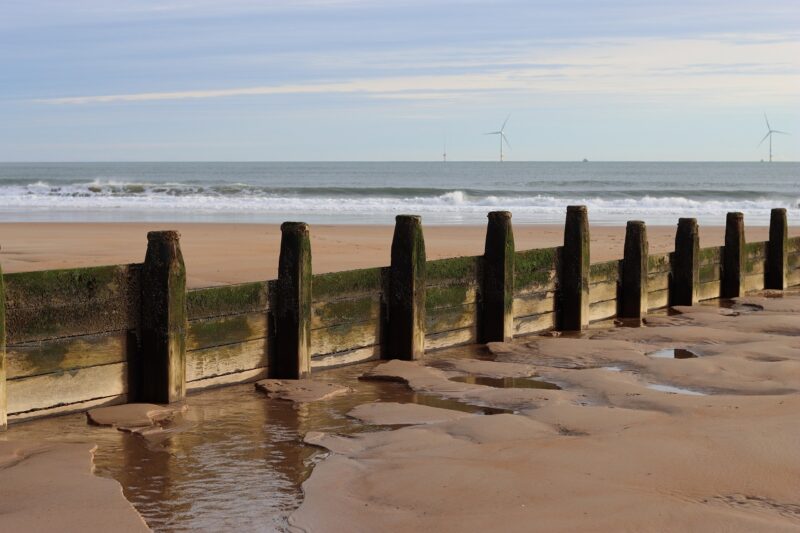
A groyne is a shoreline structure built out from the beach into the sea to intercept sediment movement and reduce erosion caused by longshore drift. Timber groynes are constructed from posts (piles) and horizontal planking, anchored into the seabed and designed to trap beach material, thereby building or stabilising beaches.
The timber species used are critical as groynes sit in one of the harshest environments imginable; alternating exposure to saltwater, waves, abrasion from shingle or pebbles, marine borers (shipworms, gribble) and cycles of wetting/drying.
In short: the wrong timber means a far shorter lifespan, higher maintenance or structural failure.
What makes timber ideal for groyne construction?
When specifying timber for groynes, the ideal material meets three main criteria:
- High natural durability (against decay, fungi, marine borers)
- High density & strength (to resist wave action, sediment impact and abrasion)
- Stability in the marine environment (resists swelling, warping, splitting)
For example, the durability class system identifies the most long-lasting species. A timber in durability class 1 (or use class 5 when in constant ground/sea contact) is ideal.
Other practical considerations include certified sourcing (FSC/PEFC) to ensure legality and sustainability, and ensuring the timber is correctly engineered. This means piles anchored deeply, using steel shoes where needed, and planks spaced and fastened appropriately.
Top Species for UK Groyne Construction
Here are the key hardwoods typically used today for groynes, with all their strengths and trade-offs:
Greenheart (Durability Class 1)
This tropical hardwood (South America in origin) offers exceptional resistance to rot, fungi and marine borers. Highly dense and structurally strong, it stands up well to constant tidal motion and abrasive pebble/shingle contact.
Ekki (also known as Azobe) (Durability Class 1)
Another tropical hardwood, Ekki, originates from West Africa. It is an extremely hard and heavy West African hardwood with great dimensional stability. It is the perfect choice for long-term sea groynes because of its ability to withstand salt water.
Oak (Durability Class 2)
While not as naturally durable as the tropical hardwoods above, oak remains a great choice, especially when pressure treated to improve its resistance to decay and marine organisms. It offers excellent structural strength, but higher dimensions are usually suggested to compensate for lower durability class.
How to select timber for your coastal defence project
When preparing a new groyne project, always follow these steps:
- Evaluate exposure and site conditions: How much abrasion (shingle, waves), marine-borer risk (salt water, tidal zone) and longevity required.
- Match to durability/use class: Aim for durability class 1 and use class 5 (full sea/ground contact) where possible.
- Choose species appropriate for budget & source: If budget allows and you want highest performance, go for Ekki or Greenheart. For local sourcing and budget constraints, oak (treated) remains a good choice.
- Check certification: Ensure the timber is FSC or PEFC-certified (especially for tropical hardwoods).
- Design accordingly: For species of lower strength/durability you will need larger dimensions.
- Plan maintenance: Even durable hardwoods benefit from inspection, maintenance for fastenings and replacement of damaged segments.
Why timber groynes remain a smart choice
While rock and concrete groynes may offer ultra-long lifespans, timber groynes bring several major advantages:
- Use a renewable material and can offer a visually more natural finish.
- Can integrate with natural habitats and promote ecological enhancement.
- Offer cost-effective construction in certain settings, especially where timber is locally available or transportation is manageable.
- Combining high-performance hardwoods with good design and maintenance results in service lives measured in decades rather than years.
Selecting the right timber species for a groyne ultimately comes down to matching specific site demands to the durability, strength and long-term behaviour of the wood. For the UK’s unique marine environment, tropical hardwoods such as Greenheart and Ekki set the benchmark, while cheaper and more locally available European species, such as oak, can be fit for purpose with careful specification, increased section sizes and the right level of protection.
Ready to fortify your coastline with timber that’s up to the job?
Get in touch with EcoChoice, the UK specialist in FSC & PEFC certified marine-grade hardwoods for groynes, sea-defence structures and civil water-engineering projects.
With proven expertise in species like Ekki and Greenheart (key for use-class 5, marine contact applications) and decades of supply to groyne and sea-defence programmes, EcoChoice helps you match specification to site conditions and durability demands.
Make your next coastal defence project count:
- Call 0345 638 1340 or email sales@ecochoice.co.uk to discuss your groyne or waterfront structure. (Ecochoice)
• Ask about species selection, lead-times, custom sizing and engineered solutions for marine exposure.
• Request project-specific documentation, durability class data and installation guidance to ensure the timber you pick is fit for purpose.
Don’t compromise on performance, sustainability or appearance. Choose timber that’s built for the waves and backed by experts. Choose EcoChoice.
Tags: Ekki, Greenheart, marine timber, Oak, timber groynes
Categories: Insights