Published: 09/02/26 By: Mike Bekin
When installing cladding, you do not have to choose a naturally durable timber species. Do not get us wrong; you absolutely need durable cladding, but there are ways of choosing a less-than-tough timber and still ticking the box for longevity. It all comes down to how the timber is treated.
To learn more about your options, here is our team’s take on treated softwoods.
What Are Your Options for Treated Softwoods
Softer timbers, such as Pine and Spruce, often come with a lower price tag than our more durable species, such as Cedar, Oak and Larch. This makes them a great choice for budget-friendly cladding, as long as you effectively treat them so that they are up to the task. There are 3 main ways of doing this:
- Thermo modification
- Pressure-treated with preservatives
- Hand-applied finishes
It is crucial that you choose at least one of these methods to ensure your timber cladding can stand up to the elements without rotting. By treating your softwood, you gain better resistance to moisture, fungal attack and insect infestation, all while creating a more dimensionally stable cladding which is going to last you decades rather than years.
Thermo Modified Softwoods
Thermo modification is one of the most reliable ways to boost softwood timber performance. This process uses high heat and pressure to change the structure of the timber at a cellular level, drastically reducing its ability to absorb and retain moisture. It is a chemical-free process which brings plenty of durability, making it a favourite amongst our EcoChoice clients (and team!).
A real highlight of ThermoWood is that it also increases dimensional stability. This is essential for cladding, where the spacing of your boards is integral to the overall aesthetic and stability of your exteriors.
The bonus? ThermoWood has a gorgeously deep, rich hue, creating a darker caramel-brown tone which designers love.
Pressure-Treated With Preservatives
An alternative to thermo modification is pressure-treated softwoods. As with ThermoWood, this process is carried out before cladding is installed and penetrates deep into the timber, boosting the durability of the entire board. Timber preservatives are, in general, designed to ensure:
- Excellent moisture resistance, slowing the onset of rot in exposed or humid conditions
- Reliable long-term performance
- A predictable service life, validated by decades of use across Europe and the UK
This option strikes a balance between affordability and dependable protection, making it particularly suitable for large developments or residential schemes where budgets are tight but quality still matters.
The main issue to be aware of is that preservative treatments can be harmful to the environment. It is important, therefore, to opt for an eco-friendly timber supplier, such as EcoChoice, for the best chance of finding non-toxic preservative-treated timber.
Hand-Applied Timber Finishes
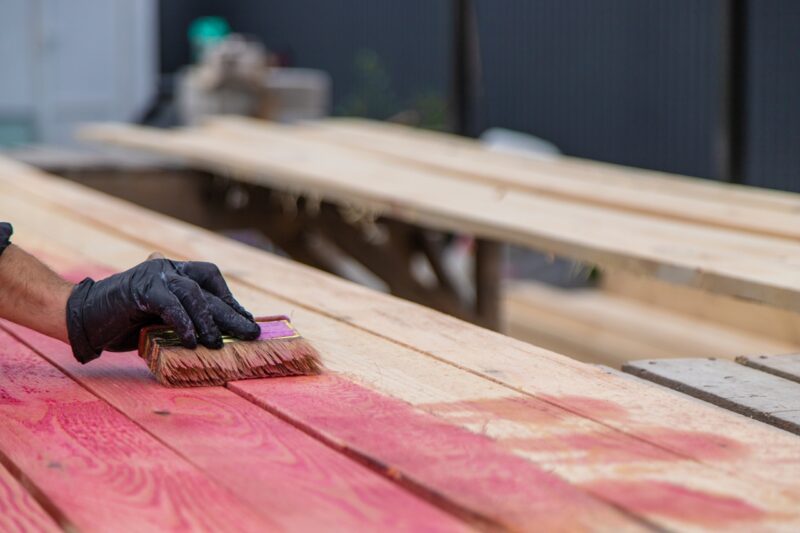
Hand-applied finishes – such as oils, stains and paints – can bring important protection to untreated timber cladding. They do not fundamentally change the timber’s structure as thermal modification does, nor do they penetrate as deeply as pressure treatments, but they offer valuable benefits when used correctly.
You can find timber finishes which bring UV resistance to your cladding, preventing the weathering process and enhancing durability by repelling water, insects and fungi. They are often cheaper than thermo modification or pressure treatments.
While not always suitable for large-scale commercial cladding, this is a great pick for smaller domestic projects. A well-maintained coating system can extend the life of your project without breaking the bank, but it does require yearly applications to maintain its effectiveness.
Find Treated Softwoods at EcoChoice
At EcoChoice, we supply pressure-treated softwoods and ThermoWood timber cladding. Whether you are working on a large commercial building renovation, a public sector new build or a bit of DIY, we can help.Start an order of treated softwoods.
Tags: softwood cladding, softwood treatments
Categories: Insights