Published: 30/12/25 By: Mike Bekin
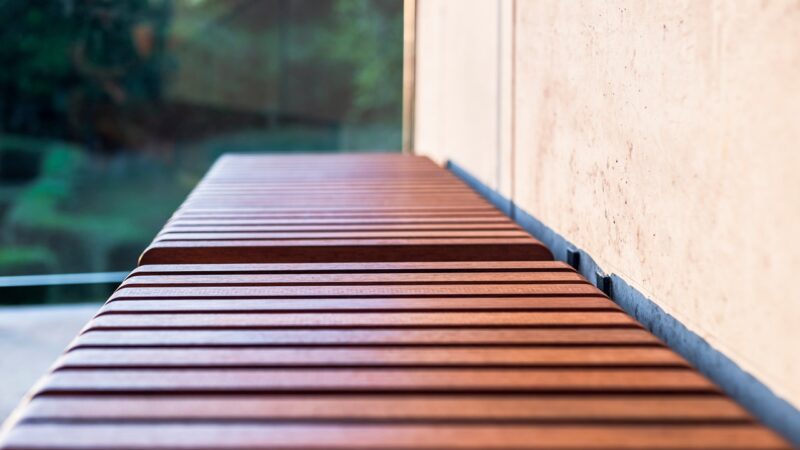
Performance matters, especially when selecting the timber species which will work for your public project. Known as ‘African teak’, Iroko is widely regarded for its versatility and durability, while its golden brown finish – which darkens over time and then fades to a nice silver/grey – makes it a popular option aesthetically. But how does Iroko fare with key performance metrics?
In this guide, we analyse the most common mechanical and physical metrics to determine if Iroko is the right timber choice for exterior joinery, cladding, decking and structural use.
Hardness
The Janka hardness scale demonstrates how resistant a timber species is to denting, wear and surface damage. The higher the hardness score, the more resistant the timber is and the more suitable it is for use as flooring, decking, steps, public benches and cladding.
With a Janka rating of between 544 and 570 kilograms-force (kgf), Iroko is relatively hard and fairly resistant to surface denting, wear and scratches. This class 1 hardwood is tougher than many common softwoods and European hardwoods. This makes it ideal for use as a high-footfall or impact-prone surface.
Density
The density of the wood can determine its overall heaviness, strength, stability and durability. Public projects benefit from high density timber solutions. Iroko boasts good density with its greater load-bearing capacity, durability against wear and stress, and resistance to weathering or damage making it a fitting choice for outdoor installations, including:
- Park benches
- Outdoor furniture
- Decks
- Boardwalks
- Cladding
- Railings
- Pergolas
Stiffness
The Modulus of Elasticity (MOE) is a key performance metric which measures how timber flexes or bends under load. Iroko is rated as fairly stiff with a MOE of 9.4 to 10.9 GPa. As a result, Iroko is perfectly suited to structural or load-bearing applications, helping to prevent excessive deflection, sagging and bounce.
Bending Strength
High bending strength and compressive strength make Iroko the ideal candidate to bear substantial loads. Its Modulus of Rupture (MOR) is 87 to 97 MPa, meaning it can handle a great deal of stress and flex before failure. This is a critical quality when choosing the right timber for beams, joists, stairs, decking boards, structural joinery and other load-bearing elements.
Shrinkage
Iroko has moderate shrinkage rates and is considered to be relatively stable even in environments with higher levels of moisture. This timber species is naturally resistant to rot, fungi, insects and decay. With this in mind, it is suitable for use in outdoor or exposed settings which are commonplace across public projects.
FSC-Certified Iroko for Public Projects
Thanks to its well-rounded profile, Iroko is an ideal timber type for a variety of public projects. This includes those which involve exterior joinery, decking, marine structures, outdoor furniture, flooring, steps, structural elements and architectural features. Hard, dense, stiff, stable and naturally durable, our FSC-certified Iroko ticks all the boxes in terms of sustainability.
Reach out to our team at EcoChoice to discover more about the benefits of using Iroko for your upcoming project.
Tags: iroko timber, performance, public projects
Categories: Insights